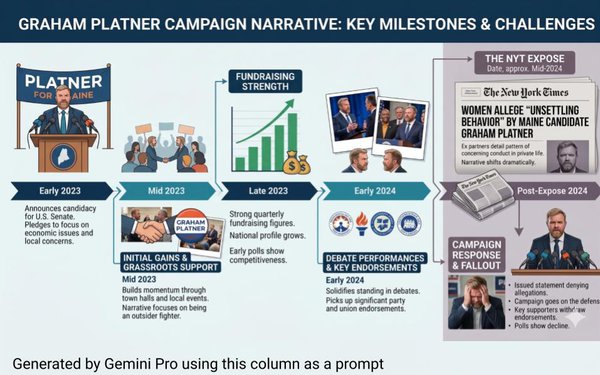
I've been thinking about "narrative
intelligence" in political media this week for a couple of reasons, not the least of which is the conveniently timed allegations of "unsettling behavior" made by several women against Maine Senatorial
candidate Graham Platner, but also because I got pitched on a new, "real-time narrative" political ad tracking service.
I have no opinions about the veracity of the claims made in The New York Times' expose, and have mainly been focused on how Platner has been
handling spin control in its wake, and what Maine primary voters will ultimately do Tuesday when they go to the voting booths.
I'm singling out Platner's narrative because in the modern
political media era of compressed, volatile and sometimes intraday news cycles, his campaign exemplifies one of the most dynamic narratives I've ever seen.
advertisement
advertisement
And his current news cycle is like a
game of three-dimensional chess, given what is at stake politically in terms of gaining a Congressional check-and-balance against a rogue, chaotic and power-abusing White House.
Do Democrats
stick to their guns about believing the women? Do they lean into Platner's redemption rhetoric that he has transformed from his questionable past to become an even better candidate? Or do they do what
Republicans have historically done and ignore the moral and ethical debate in favor of gaining control?
All I can say is I'm glad it's Maine voters who will be making that decision, because I
know they will do what's right for the state and the country.
Meanwhile, I think Platner's campaign would be an incredible poster child for the new narrative intelligence service being rolled
out this week vis a vis an integration between political ad-tracking service AdImpact and political narrative tracker PharosGraph.
The new service enables PharosGraph's "AdScape" service to
pinpoint the impact advertising has on those narratives by correlating the exact time, money, reach and creative run with real-time tracking about how it is resonating among voters.
The
service doesn't claim to monitor or predict how people may or may not vote, but it does enable political campaign teams to track how their sentiment is being impacted by a candidate's -- as well as
their opposition's -- advertising and how it is impacting what people feel, think, and ultimately, what they might do.
Like me, you're probably wondering what the impact actually is. Not
surprisingly, the new service announcement came with some examples of narrative intelligence tracking conducted in real-time: on April 12, during Virginia's state-wide ballot measure.
Here's
what it found:
- A +44% surge in opponent spending over a two-week window correlated with a two-point erosion in support, visible in real time rather than after the election.
- In key markets, opponents established two to three times share-of-voice advantages in vulnerable “Inoculate” segments before counter-messaging arrived.