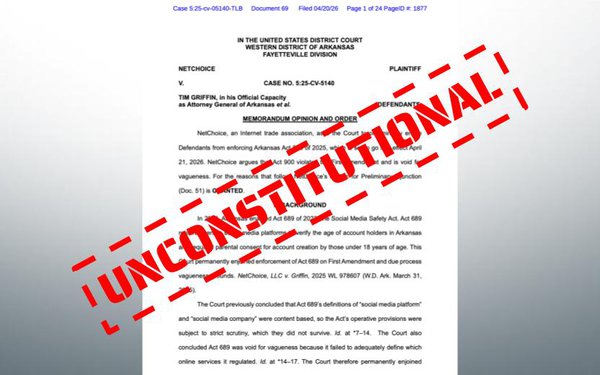
A federal judge on
Monday blocked enforcement of an Arkansas law that would prohibit social platforms from engaging in practices that could cause compulsive use by minors under 16.
In a 24-page
ruling, U.S. District Court Judge Timothy Brooks in Fayetteville said the
ban on "addictive practices" is likely too vague to be constitutional.
The Arkansas law would have required social platforms to "ensure" that they don't engage in "practices to evoke any
addiction or compulsive behaviors in an Arkansas user who is a minor including without limitation through notifications, recommended content, artificial sense of accomplishment, or engagement with
online bots that appear human.”
advertisement
advertisement
Brooks essentially found that this provision doesn't give businesses fair notice of the activity that could result in enforcement
actions.
He wrote the statute would impose liability "for a practice the evokes addiction in a single child even if it could not have known through the exercise of reasonable
care that the practice would have such an effect."
The ruling came in response to a lawsuit by the tech group NetChoice.
Brooks previously issued two
other injunctions blocking enforcement of related Arkansas social media laws.
First, in 2023 he banned state officials from enforcing the Social Media Safety Act, which would
have banned social media platforms from allowing anyone under 18 to have an account without parental permission.
Brooks said at the time that the law probably violates the
First Amendment because it “bars minors from opening accounts on a variety of social media platforms, despite the fact that those same platforms contain vast quantities of constitutionally
protected speech.” (The state legislature later changed the definition of minor to 16 for purposes of the law, but that change didn't affect Brooks' analysis.)
Last year,
Arkansas later amended that 2023 law in a few ways. One set of provisions (referred to in court papers as "Act 901") would have prohibited social media platforms from using algorithms or design
features that could "cause" a user to commit suicide, buy drugs, develop an eating disorder, or become addicted to social media.
Brooks blocked enforcement of those provisions late last year, writing that they
"clearly impose content-based restrictions on speech."
The state legislature also passed "Act 900," which included the ban on practices that could cause a minor to become
"addicted."
Another provision of Act 900 would have required social media sites to avoid sending notifications to minors under 16 between 10 p.m. and 6 a.m. by default, unless
a parent allowed such notifications. Act 900 also would have mandated the most privacy protective default settings for social media users under 16.
Brooks blocked those
restrictions as well.
"If parents wanted to prevent their children’s sleep from being disrupted by late-night notifications, they have a readily available, free, no-tech
solution already at their disposal: taking devices away at night," he wrote.
He wrote that the restriction "burdens platforms’ speech by silencing them for a third of the
day without any indication that the burden will reduce nighttime social media use or otherwise serve the State’s asserted interest at all."
Brooks also rejected the
state's argument that default privacy settings would protect minors, writing that the statute allows minors themselves to revise the defaults.
"The privacy default says nothing
about who can change these settings, leaving the Court to conclude that, because the Act imposes a mere 'default,' anyone -- parent or child -- can opt for less restrictive settings," he wrote.
"Defendants say children need this law to protect them from sexual exploitation online," Brooks added, referring to arguments by state officials. "But the law, in effect, allows
children to decide whether they need protection from sexual exploitation online because they are free to depart from the protective default."
The preliminary injunction only
prohibits enforcement of the statute against members of NetChoice, which represents many large platforms including Meta, YouTube, Reddit and Snap.