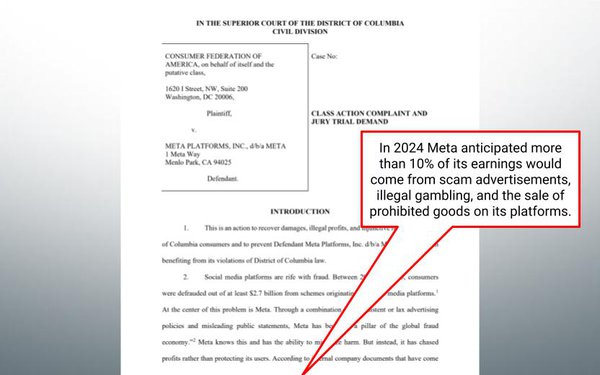
The watchdog Consumer Federation
of America alleges in a new lawsuit that Meta Platforms misleads Facebook and Instagram users about the risk that they will encounter scams, and by "knowingly targeting and profiting" from fraudulent
ads.
"Meta has knowingly taken steps and adopted policies that pad its bottom line at the expense of its users’ safety and well-being," the advocacy group alleges in a complaint filed Tuesday in District of Columbia Superior Court. "By downplaying -- and in many
cases, actively contributing to -- the proliferation of scams and fraud on its platforms and grossly exaggerating the steps Meta takes to protect users from scams, Meta has misled its users, including
those in the District of Columbia, about the risks they face every time they log onto one of Meta’s platforms, including Facebook."
advertisement
advertisement
The complaint draws on reporting about
fraud on the company's platforms, including a recent Reuters report
alleging that Meta expected to earn around 10% of its 2024 revenue, amounting to around $16 billion, from ads for scams, illegal gambling and the sale of banned goods. That report also alleged that
Meta charges more for ads if its system determines the advertiser likely is a scammer.
The group claims Meta violates the District of Columbia's consumer protection law, which includes a prohibition on misrepresenting "material facts."
Meta
allegedly made misleading statements in its terms of service and "community standards" sections, according to the Consumer Federation of America.
The terms of service say Meta
"will take appropriate action" if it detects misuse of its products or harmful conduct, and the community standards section says Meta removes content and combats behavior "that purposefully employs
deceptive means…to either scam or defraud users and businesses, or to drive engagement.”
"Facebook users who hear or see these statements would reasonably
understand them to mean what they say: that Meta is aggressively fighting fraud and scams and protecting them, so that they can trust the advertisements that do appear," the complaint alleges.
"Despite its user-facing documents and communications to the public, internal documents reveal that, contrary to its promises to users, Meta has taken steps to put its platforms’
users at risk and to ensure scam advertisements continue to be profitable for the company," the watchdog adds.
This isn't the first time Meta's been sued over phony ads on the
platform.
The company currently is battling a class-action complaint brought in federal court in California by Facebook users who say they were duped by scams. In that matter,
which dates to 2021, Oregon resident Christopher Calise alleged that he was bilked out of around $49 after attempting to purchase a car-engine assembly kit advertised on the platform, and Nebraska
resident Anastasia Groschen said she lost around $31 after attempting to purchase an educational toy for her toddler.
Meta sought a fast dismissal, arguing it was protected
from lawsuits by Section 230 of the Communications Decency Act, which broadly immunizes companies from liability over activity by advertisers and other third parties.
A trial
judge accepted Meta's argument, but the 9th Circuit Court of Appeals revived some claims and
sent the case back for trial. The appellate court essentially said Section 230 wouldn't protect Meta from claims that it broke its contract with users by failing to live up to representations in its
terms of service.
Last year, however, a federal judge in Maryland sided with Meta and threw out a lawsuit by a man who sued the company
over ads for counterfeits.
Meta has not yet responded to MediaPost's request for comment about the Consumer Federation of America's complaint.