The conservative 5th Circuit Court of Appeals on Thursday allowed Texas to immediately enforce the App Store Accountability Act, which requires app marketplaces like Google and
Apple to verify users' ages and prevent minors under 18 from downloading apps or making in-app purchases, without parental consent.
The three-judge panel didn't give a reason
for the order, which stayed an injunction issued last year by U.S. District Court Judge Robert Pitman in Austin. He said in a written ruling that the restrictions likely violate the First
Amendment.
In addition to prohibiting minors from downloading apps without parental consent, the App Store Accountability Act (SB 2420) also requires developers to say whether their apps are appropriate for children under 13, young teens
(ages 13 -15), older teens (ages 16-17) or adults 18 and older.
advertisement
advertisement
The statute additionally mandates that app developers say whether particular in-app purchases are appropriate
for children, young teens, older teens or adults.
The Texas law, passed last year, was originally slated to take effect in January. Utah and Louisiana passed similar
statutes last year, and federal lawmakers have introduced a nationwide version.
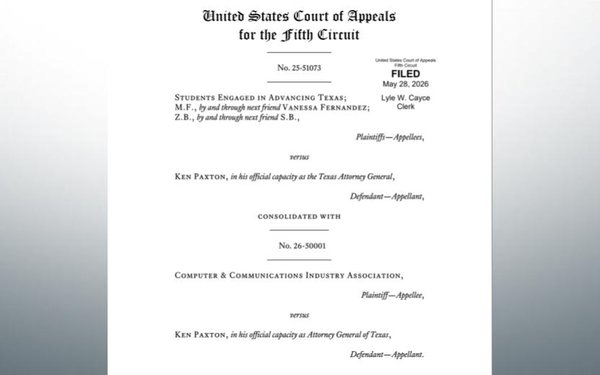
In October, the tech group Computer & Communications Industry Association and advocacy
organization Students Engaged in Advancing Texas claimed in
separate lawsuits that the Texas statute violates the First Amendment.
Numerous outside parties -- including The New York
Times, retailer associations and tech-funded policy group Chamber of Progress
-- weighed in against the law, arguing in friend-of-the-court briefs that the statute is
unconstitutional.
Others, including the National Center on Sexual Exploitation, supported the law. That group said in a friend-of-the-court brief that the statute "reinforces
longstanding requirements" regarding parental authorization for take-it-or-leave-it contracts with minors.
Pitman sided with the Computer & Communications Industry
Association and student group, writing that the statute "is akin to a law that would require every bookstore to verify the age of every customer at the door and, for minors, require parental consent
before the child or teen could enter and again when they try to purchase a book."
Texas Attorney General Ken Paxton recently appealed the injunction to the 5th Circuit Court of Appeals --
considered the most conservative court in the country.
Among other arguments, Paxton said the law represents a valid regulation of "commercial" transactions between minors and
app stores.
"When minors download apps they are accepting terms of service, including agreements about how their data is used," Paxton argued. "The child may even be agreeing
to have the information in their phone monetized by the tech companies or used to track location."
Earlier this week, the Computer & Communications Industry Association and
student group urged the 5th Circuit to uphold Pitman's injunction.
"SB2420 restricts an enormous amount of online speech in violation of controlling First Amendment precedent,"
the groups argued.
They also urged the appellate court to reject what they said was Texas's attempt "to reframe SB2420 as directed only at contracts and data privacy."
"While app store user agreements may ... authorize data collection and set terms for user privacy, the Act does not regulate those aspects of the agreements," the groups wrote. "It
instead uses age-verification at the account-creation stage to create a parental-consent obligation that specifically (and exclusively) covers obtaining apps and in-app content."
Thursday's
order lifting the injunction came before Paxton's office responded to that argument. The panel's decision, characterized as an "administrative stay," is only temporary, and the judges could still
ultimately restore the injunction in the future.
The Computer & Communications Industry Association and student group also could seek an immediate review of Thursday's decision -- either
by the entire 5th Circuit or the Supreme Court. As of Thursday evening, it wasn't clear how the challengers planned to proceed.