The Department of Justice is siding
with Elon Musk in his effort to reinstate antitrust claims against 10 advertisers that allegedly participated in a "group boycott" that resulted in a loss of X's ad revenue.
U.S. District Court Judge Jane Boyle threw out the lawsuit
earlier this year, ruling that even if the allegations in X's complaint were proven true, they would not show that the advertisers violated antitrust law.
The Justice
Department is now urging the 5th Circuit Court of Appeals to reverse Boyle's ruling, arguing in a friend-of-the-court brief filed late Wednesday that her analysis was "flawed."
"Under a proper
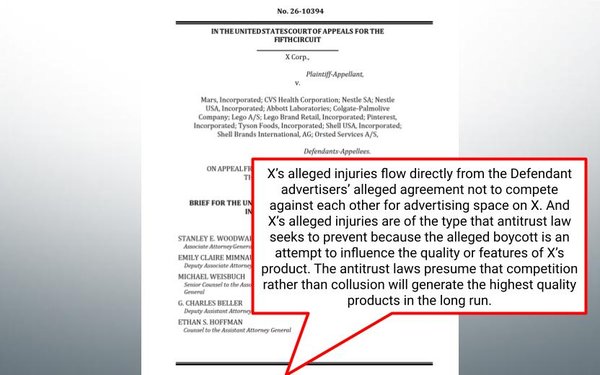
analysis, X sufficiently alleged antitrust injury," the Justice Department writes. "X's alleged injuries flow directly from the Defendant advertisers' alleged agreement not to compete against each
other for advertising space on X. And X's alleged injuries are of the type that antitrust law seeks to prevent because the alleged boycott is an attempt to influence the quality or features of X's
product."
advertisement
advertisement
The government says it is only weighing in on whether X's complaint should have been allowed to move forward, and isn't taking a position on whether the advertisers violated
antitrust law.
The new filing comes in a battle dating to 2024, when Musk's X alleged that the Belgian-based World Federation of Advertisers and its now defunct
brand-safety initiative, Global Alliance for Responsible Media (GARM), sparked a “massive advertiser boycott” that cost the company billions in ad revenue.
Musk
also sued advertisers -- energy companies Ørsted (based in Denmark) and Shell; food giants Mars, Nestle and Tyson; healthcare company CVS; pharmaceutical firm Abbott; toothpaste and personal
care brand Colgate-Palmolive; toymaker Lego; and social platform Pinterest -- for allegedly conspiring with GARM to deprive X of ad dollars.
X's ad revenue has plummeted since its 2022 acquisition by Musk.
SpaceX -- which now
includes the remnants of what was Twitter -- reported $367 million in
advertising revenue for the second quarter of 2026. By contrast, Twitter reported $1.076 billion in its last publicly traded quarter in 2022.
X recently resolved its dispute with the World Federation of Advertisers, but is appealing the dismissal of his claims against the individual advertisers.
Musk's suit came around three weeks after the Republican-led House Judiciary Committee issued a report accusing GARM of coordinating action by
corporations, ad agencies and other industry groups in order to “demonetize platforms, podcasts, news outlets, and other content deemed disfavored by GARM and its members.”
The World Federation of Advertisers shuttered GARM in August, days
after Musk sued. The trade organization has repeatedly said GARM's brand-safety standards were voluntary, and that members were free to accept or reject those standards.
X's
complaint alleged that between November 2022 and December 2022, at least 18 GARM members stopped advertising on Twitter, and that “dozens” of other members “substantially
reduced” their advertising.
When Boyle dismissed the case, she said one reason for her ruling was that X did not allege that the defendants intended to boost one of
X's rivals by engaging in the supposed boycott. The other reason was that the defendants weren't alleged to have tried to stop others from advertising on X.
But the Justice Department argues
that boycotts can violate antitrust law if "designed to force the victim to change its business behavior, such as by modifying its product, terms of sale, or with whom it will deal."