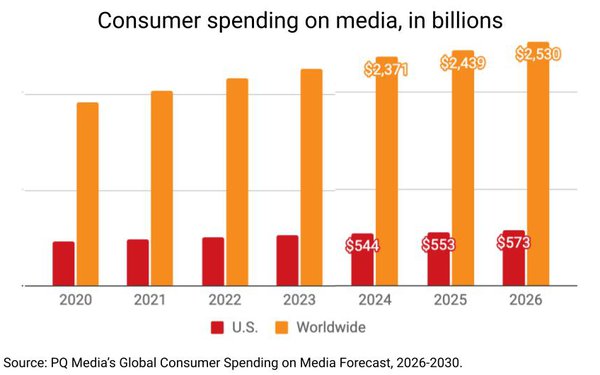
Consumer spending on media is forecast to rise 3.6% in the U.S.
and 3.7% worldwide this year, reaching new record levels of $573 billion and $2.53 trillion, respectively, according to the just released 2026 edition of an annual report from PQ Media.
While
those rates appear to be in line with overall projected rates of inflation, consumer spending on media does not appear to have been derailed by geopolitical instability, the war in Iran, and rising
energy costs either.
“Since the Iran War began, consumer confidence indicators have fallen to their lowest level in decades, even surpassing the chaotic years of the Great Recession,"
states PQ CEO and Founder Patrick Quinn, adding: "Data shows that the share of discretionary spending allocated for media content and technology peaked at 3% in 2016, but has fallen annually since,
except during the 2020-2021 pandemic when consumers were stuck at home."
advertisement
advertisement
The impact of the war, as well as exaggerated U.S. tariffs, however, appear to be impacting both developed and emerging
markets in terms of "electronically delivered content and the devices that are used to upload this content.”
The report cites a steady drop in media purchases as a share of discretionary
consumer spending, which PQ attributes to "the lack of groundbreaking new digital content or device launches, and while generative AI chatbots and other AI-enabled media technology have gained
consumer adoption, PQ says it has not yet been "of game-changing caliber" in terms of actual consumer spending.
"Consumers are not spending much money on AI, though AI has helped drive
spending on certain entertainment and workflow software," the report notes, adding: "Research currently indicates that AI remains a nice-to-have."