The good news is that when it comes to macro risks, the
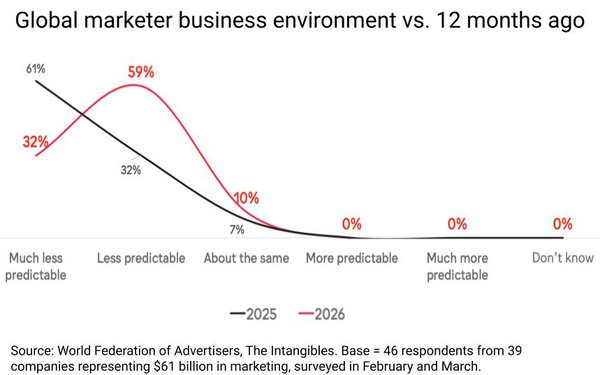
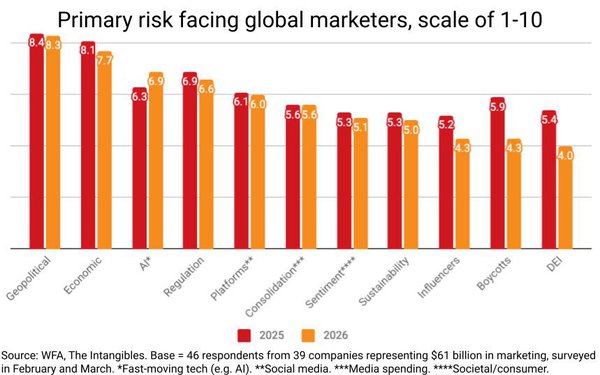
sentiment of the world's biggest marketers has tempered in the past year, according to an annual study released this morning by the World Federation of Advertisers (WFA). The concerning news is that
it has heightened for one disruptive sector: fast-moving technology, most notably AI.
"That still puts [AI] behind the geopolitical environment and economic trends, but it now rates ahead of
tightening regulations," the WFA states in its analysis of the study, which was fielded in February and March among 46 respondents representing 39 companies spending $61 billion in marketing.
While the respondent bases is not exactly the same -- the WFA surveyed only 29
companies in 2025 -- it shows that overall risk remains high, but the fastest-growing one is fast-moving, disruptive technologies.
advertisement
advertisement
That was something echoed during an Institute for
Advertising Ethics (IAE) summit devoted to the ethical implications the acceleration of AI has for advertising in New York City Wednesday.
The summit, which was held in conjunction with the
technology engineering standards association, the IEEE SA, was off-the-record and I agreed not to report on it, at least for now.
But I can tell you it is part of a planned series of IAE/IEEE
SA summits intended to surface new ways of thinking about advertising in an "agentic era," including -- potentially -- increased consumer agency vis a vis emerging marketing practices enabled by the
IEEE SA's new technical standard P7012, developed in collaboration with Project VRM, which has been
dubbed "MyTerms."
As I've reported before, the MyTerms standard enables machine-readable interactions between consumers and brands, which still is
a little aspirational,\.
But at least it is being cultivated by groups like the IAE, IEEE SA, Project VRM, and a number of fast-moving developers hoping to usher in a new paradigm for consumer
marketing -- one in which there is more of a symmetrical information flow than the asymmetrical one that has historically existed in consumer marketing, especially in recent years that have led
identity data-based targeting and the rise of "Surveillance Capitalism."
I bring this up because one thing I can share from Wednesday's summit is a brief presentation I made to the attendees reminding them that the idea is not new -- i has just taken a while to come to
fruition. The concept was originally outlined by big thinkers like "The Cluetrain Manifesto" author Doc Searls.
Searls' work certainly inspired my thinking as a trade journalist and corresponded with an ad-industry initiative that I also participated as a fly-on-the-wall journalist in: the Advertising
Research Foundation's and MIT Media Lab's "Project D-Map," which developed a model for forecasting the long-term impact digital media would have on advertising.
D-Map actually developed an
"operating system" its sponsors could use to scenario plan various outcomes based on inputs around key factors, most notably regulation, societal sentiment, consumer adoption, and technological
innovation.
I bring that up here because it seems to mirror the sentiment tracking the WFA has been tracking the past couple of years, and I will tell you, the biggest single factor -- and the
most unknown one -- back when Project D-Map was conducted in the year 2000 was technological innovation.
I remember sitting in a room at the MIT Media Lab when one of the presenters was
demonstrating one example of tech innovation that was likely to impact how consumers use media. He called it "WiFi" and I was so inspired by his wireless, interconnected laptop presentation that I
went up to him afterward and asked him if it was something I could do at home.
He gave me some internet "protocol" info, I went out and purchased a ridiculously expensive first-generation
router from Cisco, and spent months trying to get it to talk with my internet service provider.
My wife thought I was nuts, but when it finally worked it was like a magical lightbulb moment.
Neighbors literally came over to see it, oohing and aahing at the spectacle of wireless internet connectivity.
The the standard for WiFi was created by the IEEE.
The real point of my
Project D-Map experience was the scenario thesis it ended with. During a multi-day symposium in MIT Media Lab's Cube, academics, techies, agencies and big marketers described a future in which
consumers and brands would have digital technology "filters" enabling them to interact with each other on an entirely symmetrical basis.
Today, we call those "filters" agents, and my personal
pitch to the gathering of industry execs Wednesday was that we need to develop a new kind of "agency" to finally make that happen.
I dubbed it "Agent/c," because they should be agents trained
to represent consumers -- not brands, ad "agencies" and Big Tech -- to enable a new kind of efficient consumer marketplace symmetry.
I think that is the ultimate goal of MyTerms, Project VRM,
the well-intentioned people in the room at Wednesday's IAE summit, and what Doc Searls means when he talks about the "intention economy."
I just hope it doesn't get hijacked and exploited by
forces seeking to game it for economic advantage. That's the real challenge.
Anyway, the WFA's just-published "Global Risk Barometer" triggered this column, because I agree with the respondents who say "fast-moving
technology" is the fastest-rising disruptive risks for marketers.
But depending on the scenario you want to look at, it could also be their fastest-rising opportunities.