It's been a year since I first began asking ad industry execs --
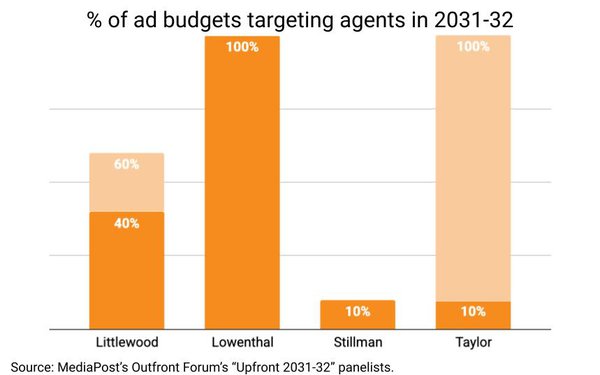
chief investment officers, pure-play digital techies, brand marketers, anyone who will answer me -- to predict what share of ad spending will be targeting AI agents -- not humans -- in five years.
When I asked that question to panelists on my "Upfront 2030-31" panel at last
year's MediaPost Outfront Forum, the range was from 0% to 100%, but excluding my own prediction (80%), the average was 24%. Since then, the delta has been growing, and when I asked it to "Upfront
2031-32" panelists at Tuesday's "Outfront Forum," it also ranged considerably, but averaged more than 50%.
advertisement
advertisement
You can watch the discussion in the video embedded above, but there were lots of caveats about
what even constitutes a media buy -- now or in five years -- and how much of it would be "organic" targeting vs. "paid" media targeting aimed at agents.
The current state of the artificial
intelligence (AI) marketing craft -- as outlined by Brandlabs' Andy Littlewood and MRM's Jon Taylor -- is more akin to organic search optimization: influencing the brand affinity of the LLMs (large
language models) that currently are changing consumer behavior, which for now at least, has meant a deprecation of the traffic generated by search due to so-called AI overviews answering consumer
queries without linking elsewhere.
You can learn more about the "share of model" model by watching Littlewood's colleague -- Exverus'
Hillary Kupferberg's presentation at MediaPost's recent Planning & Buying Summit.
I recommend it, because she examines just how volatile the brand affinity is for LLMs due to the
sources they are drawing their data from.
That's because they don't necessarily have access to elite data sets and are still getting most of their information from publicly accessible
databases -- Ie. Wikipedia was dominant, then Reddit, and more recently, YouTube. You get the idea.
But when I ask about the shift to a model using paid media to influence the brand affinity
of AI -- LLMs today, but more likely, consumer-facing agents in the not-too-distant future -- I sometimes get that look like I have two heads on my shoulders, but for those who get it, I think it's a
the most logical outcome (see Barry Lowenthal's comments in the "Upfront 2031-32" video).
Needless to say, others, like Madison and Wall's Luke Stillman, remain markedly more grounded
about that.
As a mental exercise, I recently tried calculating the amount of ad spending already targeting AI-generated bots today, and I came up with nearly $100 billion, or about 10% of
today's global advertising marketplace.
Obviously, the lion's share of that spending is the bad kind -- fraudulent non-human traffic reaching bots, not the humans the media buys were intended
to reach.
But a significant amount of it -- an estimated $6 billion -- is being spent on "intentional" media buys targeting agents explicitly: virtual influencers in the $30 billion-plus
influencer marketing marketplace.
By the way, I'll be publishing the deck that analysis is part of in an upcoming column here. I think you'll find it interesting.
But if you can't
wait, you can see the presentation of it I made at MediaPost's recent planning and buying summit here. Warning: it contains sensitive
content that may not be suitable for some people.
I suspect non-human ad fraud will persist for some time, but I've also written about how the inverse will likely happen: advertisers being
defrauded of ad spending aimed at agents credited to "invalid human traffic."
I mean, ad-fraud mitigation giant DoubleVerify has already created a service for advertisers to validate non-human
traffic aimed at agents and filtering the traffic reaching invalid non-human and human traffic. And that's last year, not five years from now.
Please watch the "Upfront 2031-32" panel
discussion above and tell me what you think in the comments on this post or at joe@mediapost.com.
Personally, I'm still mostly just riffing on all of this rapid AI-powered disruption and
marketplace model shift, but whether we see a truly "agentic" upfront -- or any other form of media buying -- five years from now probably isn't really the point from my POV. It's that AI will usher
in the biggest shift in the historic information asymmetry of the consumer marketing marketplace of my career covering this business, and arguably, in all of human history.
I'm looking forward
to attending the Institute for Advertising Ethics' invitation-only "The Intention Advantage" summit in New York City. Stay tuned for more
on that.
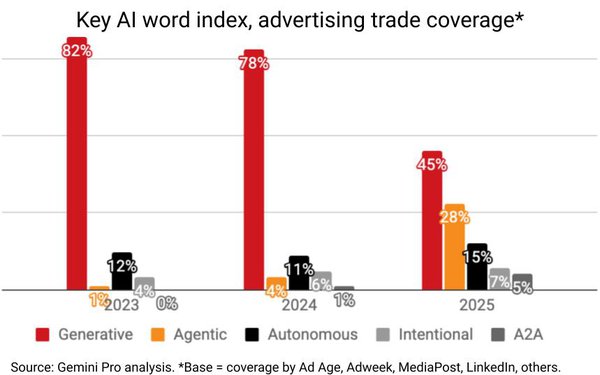
I'm also predicting that "intentional AI" will be the industry's next big buzzword bingo winner, following "generative AI," "agentic" (the ANA's marketing word of the year in 2025),
and "autonomous" (increasingly gathering momentum now).
In fact, I went to one of my favorite LLMs -- Google's Gemini Pro chatbot -- and asked it to do some back-of-the-envelope estimates for
me.
Take it with a grain of salt, but here is its keyword indexing of trade press coverage of the buzziest AI marketing-related words.
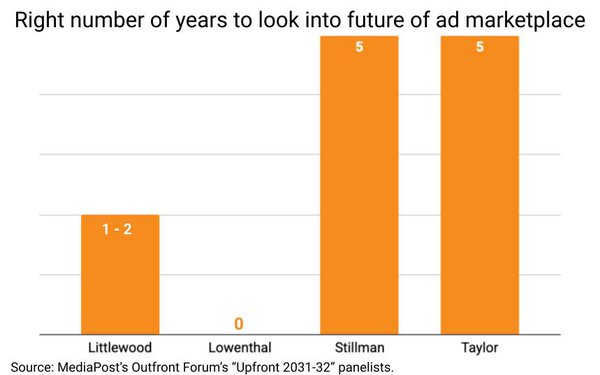
Final note: I also asked this week's "Upfront 2031-32" panelists what the best amount of time
was for reasonably predicting the not-too-distant future of media disruption on the advertising marketplace.
I asked because during our panel prep call some said -- given the acceleration of
technological innovation -- that five years may now be too far out. Here's what they said: