Stitch Fix is back. The personal styling service reported 9.4% revenue growth in its most recent quarter -- its second straight quarter of sales gains. CMO Debbie
Woloshin knows part of the reason: People are starving for a little style validation.
"We heard from one in four clients that they hadn't received a
compliment on their outfit in 30 days," she says, “and 70% would second-guess their outfit before they leave the house.” That insecurity, is a big deal, with 49% saying they’d
potentially cancel plans if they didn't like the way they looked, she said.
Sad statistics? Maybe. But for Stitch Fix, they became a creative brief, and a new
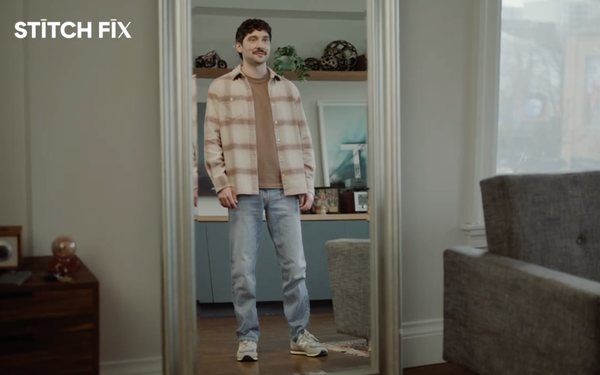
way to extend the "Retail Therapy" brand platform launched last year. “Mirror Mantras” is built directly around the idea
that confidence in what you're wearing doesn't just affect how you look, it shapes how you show up. The spots, developed entirely in-house, feature the kind of small, charged moments of
self-recognition that Stitch Fix clients described in their own words: Catching your reflection and thinking, for once, hey, I look good.
advertisement
advertisement
“A-plus on the outfit, Ms. Turner,” a teacher congratulates herself. “Not today, sweatpants,” one guy tells his mirror. “Somebody is
wearing jeans that fit.”
The company launched the new ads with a promotion tied to National Compliments Day on Jan. 24, along with a guarantee for
new clients that if they didn't receive a compliment within 30 days, their next Fix was free. Stitch Fix’s confidence appears to be well-founded because, so far, 85% of surveyed clients say the
brand feels like a fit for them. And the team is turning some of the best responses into new vignettes.
What makes all of this possible, Woloshin tells
Marketing Daily, is many years’ worth of insight mining, rapid creative development and personalization at scale. The San Francisco-based company, founded in 2011, has been building its
underlying AI engine since long before most brands knew what machine learning was. The company now has roughly 40 AI use cases in its marketing operation alone, from automated search engine marketing
bidding that has freed up 80% of its team's time, to Vision AI, a tool that lets clients upload a selfie and receive weekly images of their own likeness styled in three different looks.
"We even say in some of our ad units: 'powered by AI, styled by humans,'" she says. "There's nothing more personal than getting dressed, and we have a human in the
loop who really knows you."
Woloshin, who recently presented the company’s evolving AI strategy on a panel at SXSW, says one of the major marketing
advantages of being a machine-learning pioneer is that the company is already comfortable with the idea of tech constantly evolving. And while other companies are beating their chest about going
“all in” on AI, or remaining adamant about human involvement, “we’re comfortable leaning into the balance. We don’t need to draw a line in the sand. We’ll continue
to test, and continue to iterate -- because we understand that the human element is not going away.”